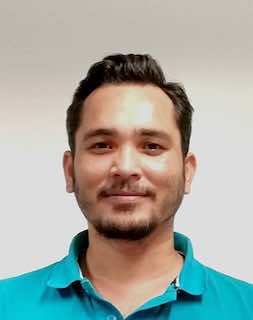
 Faculty Name:
Amal Sarkar
Faculty Name:
Amal Sarkar Designation: Assistant Professor
Dr. Amal Sarkar is an experimental high-energy physicist whose primary research focuses on searches for physics beyond the Standard Model (BSM), particularly exotic particles, new resonances, and rare signatures at high-energy colliders. His research aims to explore the fundamental structure of matter and identify possible signatures of new physics using data from the Large Hadron Collider (LHC) at CERN and other current and future accelerator facilities. His broader research interests include collider physics, QCD, heavy-ion physics, and advanced particle-detector development.
His research also focuses on QGP and heavy-ion physics, with particular emphasis on the QCD phase diagram and the search for the QCD Critical Point, QGP dynamics, and the use of heavy-flavor and electroweak probes to investigate the properties of strongly interacting matter under extreme conditions. His theoretical and phenomenological studies include Polyakov–Nambu–Jona-Lasinio (PNJL) model phenomenology, QCD phase transitions, and fluctuations, with the aim of establishing connections between the microscopic description of QCD matter and experimentally measurable observables in high-energy nuclear collisions.
Dr. Sarkar is also involved in advanced particle-detector development, including GEM, Micromegas, RPC, and other MPGD-based detector technologies. His detector research focuses on the development, optimization, and characterization of instrumentation for high-energy and nuclear physics experiments, with additional interest in detector technologies and techniques with multidisciplinary applications.
Research Interests:
1. BSM & LHC Physics: Search for Exotic & Resonances · New Physics Searches · Collider Phenomenology
2. QGP & Heavy-Ion Physics: QCD Phase Diagram & Critical Point · QGP Dynamics · Heavy-Flavor & Electroweak Probes · PNJL Phenomenology
3. Detector Physics: GEM/Micromegas/RPC/MPGD Detectors
International Collaborations:
1. CERN–LHC: ALICE · CMS · DRD1
2. BNL–RHIC/EIC: STAR · ePIC